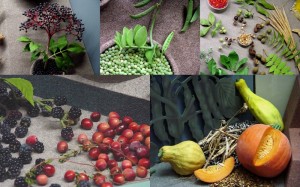
Plant models by Gary Hoyle. All rights reserved
Do you see an open shoebox laying on its side containing a scene depicting life at one of California’s historic missions? How about a mountain scene? A desert scene perhaps?
While smaller and much simpler in construction, the classroom diorama is really no different from the dioramas seen in natural history museums. What they have in common, is they are all snapshots of life occurring at a site-specific location.
Dioramas were patented by Louis Daguerre in 1822 (Hoyle, 2008). Daguerre was a stage designer in the theatre and the inventor of the daguerreotype (Hoyle, 2008). Daguerre’s “stage window” (Hoyle, 2008) eventually evolved to become the nature scenes we know today.
These incredibly detailed landscape scenes are created by a dedicated team of curators, scientists, historians and artists who work together to connect the public to nature. Artists such as Gary Hoyle who specializes in creating representational work for museums.
How did Gary’s museum career get its start?
When Gary was ten years old, he saw his first wildlife diorama at the Museum of Science in Boston, Massachusetts. He says that after this visit, he became obsessed with creating environments for the clay animals he made as a young child. When he was fourteen, he was invited to watch Klir Beck, curator of the Maine State Museum, create the Black Bear Diorama. Sometime after this experience, he showed Beck his animal sculptures and, to his surprise, was invited to sculpt two box turtles for another exhibit. Months later, a 15-year old Gary presented the turtles to the Governor of Maine during a ceremony at the museum.
After high school, Gary studied biology instead of art because he had little interest in abstract art, which was the focus of art programs at the time. While he wanted to combine art and science in some way, Gary felt a burden to be practical because “the whole idea of having a profession in ‘diorama art’ seemed more like a childhood dream than anything remotely possible in the 1960s.” Because there were no scholarships and no way to create a degree with an interdisciplinary focus, Gary studied zoology at the University of Maine.
Years later while finishing up his degree and during his three years of teaching, Gary checked-in with the Maine State Museum periodically to see if they were hiring. In 1973, he was hired as a Research Associate in Natural History at the museum’s new home in the Maine State Cultural Building. Gary’s mentor for those first ten years was Fred Scherer. Scherer had retired from the American Museum of Natural History (AMNH) in New York and worked at the museum in Maine once per week as a museum consultant. Gary says Scherer taught him the techniques he learned as a preparator during his 38-year career at the AMNH. From Scherer, Gary learned how to make small plants, ledges, leaves and trees for the foregrounds of dioramas. He also learned some of the painting techniques Scherer had learned while working as a background painter for legendary artist James Perry Wilson. Gary says he still learns from Scherer, now 97, by phone and when he goes on walks. Gary says, “…when I walk in nature, (I) remember his advice.”
Gary’s first challenge in creating botanical specimens occurred after his mentor left the museum. While he had a good foundation in plant fabrication, this new project required Gary to create hundreds of berries, fruits, plant parts and life-like plant specimens for an exhibit about native American edible plants. Adding to this challenge was the size of his work space — a 12′ by 16′ lab at the museum. Gary says he had to do a lot of experimenting before he could even create his first plant specimen. At the time, there was only one other person in the US creating plant models in wax (Gary’s preferred medium because of its low toxicity). This other person was Dick Sheffield at the Museum of Science in Boston. Gary contacted Sheffield and Sheffield provided a lot of helpful advice about working with wax. Even with all of Sheffield’s generous advice, Gary said, “collecting, color noting, preserving, mold making, wax coloring, casting, fabricating and mounting consumed two years of my work days.”
Today Gary works as an exhibits consultant and a visual artist whose specialty is representational works for museums, corporations and individuals.
This month we have the unique opportunity to learn about plant models, exhibit design and dioramas from an expert with forty years experience in the museum field.
Please join me in welcoming Gary Hoyle, our featured guest for October.
Literature Cited
Hoyle, Gary. 2008. From theatrical illusion to ecological theater: The development of the classic wildlife diorama. Journal of the Guild of Natural Science Illustrators. Volume 40, Number 8.


 ArtPlantae Today
ArtPlantae: When presented with the challenge of creating a realistic model of a plant, which features of a plant tend to dictate how you proceed with a project? Do you consider its overall habit first? The thickness of its leaves? The position of its flowers?
Gary: Let’s back up just a little, because the first thing I have to consider is “what is the purpose for the model?” For instance, some models are “frozen” in a specific instance of time – season of the year or perhaps some point in its life cycle. Other models may be to demonstrate an entire life cycle in one specimen or a series of seasonal changes across parts of a single plant. What will be the viewer’s distance? Some models are viewed at close range, others are viewed from several feet away. And what about the field of view? Is it restricted as in a diorama or will the model be seen from all sides? And finally, what is to be the intended life span of the model? Is it for a temporary exhibit of several months to five years, or is it for a permanent exhibit of 50 years or more? Once these questions are answered and a price is set I can address those questions that you’ve set before me.
If by “habit” you mean the gesture apparent in the plant, I try to take that attitude into account first and keep it consciously in my mind as I work. However, when I actually fabricate the plant, I create molds of fruits, leaves, tubers, etc. first. I then begin to work at the top of the plant from the inside out to build flowers and attach fruits, leaves, etc. As I work, I always try to be aware of the plant’s Gestalt [or gesture or habit] so that I do not have to make major adjustments when I’ve finished the model.
ArtPlantae: Years ago, I attended your presentation about model making at a GNSI conference. I gained a new appreciation for museum plants and dioramas within minutes. So many materials are used to create a model! What type of supplies do you use when making realistic models?
Gary: If the model is to be used in a permanent exhibit, I try to use materials that I know will last at least 50 years. I like to use sun bleached beeswax because it has a proven track record. However, in thin sheets such as wax leaves, the material can become brittle within a few decades. To counteract that tendency, I’ve been working with a combination of paraffin wax and hot melt glue and had some success. But I use only beeswax, wire and cotton on the stems and pure beeswax in fruits, tubers, etc. And I always use light fast pigments to color my wax. Sometimes I use crepe paper, string, thread, twine even scrub pads as support structures for the wax.
ArtPlantae: In your conference presentation, you made a distinction between making “highly realistic display pieces” and making simple models illustrators can use as tools. Nothing looked simple to me on this day. What would a “simple” model look like?
Gary: The availability of the specific plant species dictates what a simple model would look like. Let’s take the branch of a deciduous tree for instance. If you have one in the neighborhood and it’s not winter or early spring, you can pluck a few leaves then use a copy machine to create your leaves. When you do this, don’t forget to place the leaves on the enlarger dorsal surface down. Some craft stores even supply spray cans of paints that you can use to match the leaf color if necessary. Spray lightly over the copied sheets to avoid obscuring details. After drying you can also paint the ventral surface if you like. Once the leaves have been cut, place them one at a time face up on a slightly pliant surface, then carefully emboss the venation. Afterwards, turn the leaves over and glue a wire along the mid-vein. When the glue has set you can emboss the ventral surface or just bend the wire and give a general shape to the leaf, then cut a piece of plastic spaghetti tubing (purchased from an electronics supply store) which is the approximate length and thickness of the petiole and slip it over the wire. Paint the “petiole.” Cut a section of branch then drill holes into the leaf scars and insert the wires with a bit of fast drying glue. Finally, secure the branch to some type of base and shape the leaves into their characteristic gesture. If you don’t have the species around, check out guide books that may have line drawings that you can enlarge then follow the same procedure that I’ve outlined, or check in a craft store where artificial plants are sold and see if there are some you can modify for your purpose.
You can go even simpler in the process, but the example above gives a good, quite realistic looking model that can last for years if kept out of direct sunlight.
ArtPlantae: In reviewing the literature about dioramas, I noticed that the educational value of dioramas is a topic that comes up often. In your article, Saved From the Trash, you state that dioramas are in danger of disappearing because they are considered to be “outdated displays.” How do you defend the value of dioramas when others want to replace them with, say, something more interactive?
Gary: There is a stark difference between an interactive exhibit and a diorama. Certainly interactive exhibits fit well with our cybernetic lifestyle. Dioramas do not, and that makes the diorama even more unique in today’s world. The “time freeze” in such an exhibit does not mean that the diorama is a contemplative and therefore outdated exhibit model. If done well, a diorama can evoke a powerful potential energy. Muscles straining on a tiger crouched in the grass or a ruffed grouse ready to bolt from cover can awaken something primal if we are willing to stop and really look. Publishers assumed that a child’s attention span was too narrow to read a book of over a hundred pages until J.K. Rowling blew that theory out of the water. The same is true of a diorama. I have seen young children, and adults too, thrill to that type of exhibit.
I have nothing against interactive exhibits. I actually think certain types of interactive exhibits keyed to elements within a diorama can enhance the visitor’s experience of both forms of exhibition. My concern is indiscriminate removal of dioramas, particularly in natural history museums where there is less regard for cultural history. Some of the dioramas in natural history museums motivated people into a conservation ethic that resulted in the establishment of many of our national parks and wildlife reserves. Very few of those iconic displays survive today because they became considered “outdated” years ago and were demolished. Art historians, such as Karen Wonders who has linked the wildlife diorama to the greater history of art, lament the loss of even greater numbers of these unique exhibits.
I am not saying that all dioramas in natural history museums should be saved, but it is important for those museums to recognize that their exhibits influence the culture and that over time some of those exhibits become cultural icons. For an administrator of a natural history museum to say, “We are a museum of science not history”, displays an ignorance of the value of exhibits. A national committee is needed to advise museums on the cultural and artistic importance of their dioramas. It is my hope that some day a “Museum of the Diorama” will be established to house some of the unwanted but important dioramas where their history and artistry can be explored. In the meantime, if historically important dioramas must be removed, they should be fully documented, and all elements including the curved backgrounds should be archived. Fortunately, the tide is beginning to change. I’m hearing more and more concern about caring for older dioramas among museum professionals.
Literature Cited
Hoyle, Gary. 2010. Saved from the trash. Journal of the Guild of Natural Science Illustrators. 42(8): 32-37
I stopped by the Riverside Metropolitan Museum the other day and saw a very nice example of a diorama. It is a view of Barton Flats in the San Bernardino National Forest. The diorama works because everything in front of the painted background is moving.
The elements above work together to bring life to the scene and help to establish an emotional connection to what is going on in the local forest, even though the viewer is many miles away.
What you’ve described is a very skillfully designed and constructed diorama. The team that created it understands the essence of what that type of exhibit is meant to convey. In a nutshell, a well done diorama gives the sense that the viewer has been transported to a place and time where he or she have come upon an intimate moment of nature or history. That is the power of the diorama – to create an illusion that gives a sense of place and time. All of the “motions” that you describe are of course illusionary, but they are what “breathe life” into a static exhibit. No other exhibit type does this as effectively as a well done diorama.
ArtPlantae: The dioramas in the Hall of North American Mammals at the American Museum of Natural History (AMNH) are in the process of being restored. The New York Times featured a story about the restoration last year. This article includes a behind-the-scenes video of diorama artists at work. The article focuses mostly on the restoration of mammals. My question to you is… what about the plants? The shrubs, grasses and trees surely fade over time like the fur of the mammals. How do you freshen up a 30-year old plant model?
Gary: Well, I guess I could give a general answer. A 30-year old model might need some cleaning with a gentle current of air from an air brush and the use of a dry sable or camel hair brush, and very likely it will need a color restoration because of prolonged exposure to exhibit lights. However, the truth is that every situation is different, and sometimes it’s necessary to consult with specialists such as painting and objects conservators especially when dealing with exhibit models more than 50-years old.
My mentor, Fred Scherer, worked on several of the exhibits in the AMNH Hall of North American Mammals over 60 years ago, and also on those in the African Hall over 75 years ago. He told me that during that time a lot of experimentation was going on. Much of the early leafy vegetation was constructed with wax, wire and cotton, but the hot exhibit lights caused the leaves to droop so that every few years exhibits had to be re-opened so that the leaves could be gently warmed and repositioned. Once the shift was made to fluorescent lighting in the 1940s the problem subsided. However, by then vacuum formed acetate plastic was being used for leaves and other plastics were being used for various other plant fabrications. And not all plant fabricators were willing to share their methods. Thus, restoration of a plant model more than a half century old can be very challenging.
I think that one of the reasons the New York Times focused only on the restoration of animal mounts is that they are usually the focal point of a diorama and they’re a “sexy” subject for a newspaper article. The other reason is the chemical complexity of an animal mount, because the restorer is usually dealing with real skin and hair treated with a variety of preservatives which creates a major challenge. Steve Quinn, Head of the Exhibition Department at the AMNH, talked with me about this nearly a decade ago when he and I were giving presentations on the preservation of wildlife dioramas at the John Ford Bell Museum of Natural History in Minneapolis, Minnesota. However, we also talked about the difficulties of restoring old plant models and the fragility of even wax models that were over 50 years old. By then crystal formation and the loss of volatiles has made wax petals and leaves more fragile than glass. While we were at the museum, one of the dioramas created in the late 1950s was opened to us for inspection. A museum exhibits contractor unfamiliar with this aging effect lightly touched a wax flower, and to his shock and embarrassment it disintegrated.
So even though animal mounts get the press coverage, competent restorers of dioramas are very aware of the challenges of restoring artificial plants.
Do you have a question about dioramas? Plant models? Exhibit design?
Post your question in the Comment box below.
I loved your explanation, Gary, of how to make the plant replicas. I have been actually trying to learn about how you do what you do, and take a class from you, but it hasn’t worked out. My question to you is, when you print out the venation on a piece a paper, before you shape the leaf, are you using archival paper, and what paper is best to use?
Victoria Fuller
Perhaps I can help you, Victoria, in more than one way. First let me answer your question.
I believe it was in the 1980s that industry shifted to producing acid free photocopy paper. Conservators now consider photo-copy paper archival. And I do believe there are now archival inks [check with the manufacture]. My recommendation for using a copy machine to create artificial leaves is intended for studio models kept in reduced light and having a projected life of 5 years. However, using archival inks and papers should definitely extend that projected life by a considerable number of years. By how much, I can not say. The application of paints on paper will also have some effect on the chemistry of the paper. Oils, for instance will create an acid condition over time as they oxidize. I’d stick with watercolors or acrylics lightly sprayed with an airbrush or even a mouth atomizer. Just don’t soak the paper or it will buckle and the ink may run. Also, if you find that photocopy paper is too thin for you to get the embossing effect that you want, there are heavier weight archival papers that can be run through copy machines. I don’t have all the answers because I’m still experimenting myself, but that’s the fun of it.
Now here’s another way I may be able to help you. I know that you are a GNSI member. I am hoping to offer a workshop on plant model making at the Guild of Natural Science Illustrators Conference next year at College of the Atlantic in Bar Harbor, Maine. Hopefully, I’ll see you at the workshop.
ArtPlantae: I have noticed that when visitors approach a diorama, they tend not to spend too much time looking at the scene. I am not so sure visitors really see the relationships and the actions depicted before them. What do you hope visitors see when they stop to view a diorama?
Gary: Here is where an interactive exhibit keyed to elements in a specific diorama can enhance the visitor’s experience by encouraging individuals to linger longer at a diorama. Some diorama scenes are subtle and extremely sophisticated from a scientific standpoint. The older ones that are site specific such as those in the Hall of North American Mammals at the AMNH may even show a plant community that no longer exists. Fred Scherer told me that he and James Perry Wilson had to paint out some of the sage brush in the background of the Bison Group [at the AMNH], and the foreground grass had to be replaced with another species after an elderly man in buckskin, who had lived on the plains when bison were plentiful, pointed out the museum’s error. Such important subtleties are rarely noticed by visitors.
I think most people who work on wildlife dioramas would agree with me, that their primary goal is to give the visitor the illusion of being in a frozen moment of the natural world untouched by civilization. We want that experience to provoke not only an appreciation of the natural world but a desire to protect what remains of the diverse habitats in our biosphere.
Thanks Gary, If I can do the conference next year. I would really like to take your workshop.
Readers, if you missed it…today’s teaching and learning column is about using dioramas in biology education. The authors raise some concern about the messages dioramas send. If you’re interested, go to http://artplantaetoday.com/2012/10/12/using-dioramas-to-teach-biology