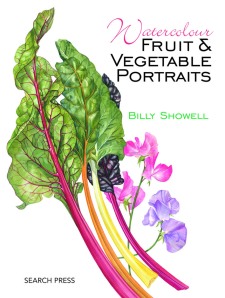
 We would like to thank Billy for taking time for this interview and for taking artists’ questions. When we brought her book, Watercolor Flower Portraits and the preview of Watercolor Fruit & Vegetable Portraits to the ASBA conference in October, artists who had a copy of her flower book spoke highly of it to those around them. The sneak peek of the book about fruit and vegetables drew a lot of attention. We would like to thank Billy Showell and Search Press for allowing us to share the new book with our audience. Our interview with Billy follows…
APT: You were trained as an illustrator and worked as a fashion illustrator and surface designer, am I correct? It seems like many botanical artists have a background in fashion illustration and surface design. What did you do as a fashion illustrator &/or surface designer? What prompted you to pursue a career as a botanical artist?
Billy Showell: I trained at St. Martins college of art and design as a Fashion Designer/Illustrator and thoroughly enjoyed the course. But once in the fashion business I was extremely unhappy (and> I realised it would take years before I could get to the position where I would enjoy the job, so I left to help my husband in his work painting murals.
It was while I was painting some furniture that someone spotted my work and suggested that I do some oil paintings on canvas, which I did, and they sold. Spurred on by this, I continued to paint and later moved on to watercolour. The botanical work was really by accident when I started to teach watercolour. A slot (for) a botanical teacher came up and my style of painting seemed to fit and that was the start of the botanical road for me.
APT: You exhibit your work regularly in exhibitions. Not only have you participated in an impressive number of exhibitions, the number of pieces you have on display on an annual basis is impressive. How do you organize your time?
Billy Showell: I have a studio in the garden where I paint most days while the kids are at school. At 4 o’clock I stop but occasionally will return to paint in the evening. I always prefer to work to a deadline, the pressure helps me to focus. Also my approach to watercolour is faster than the more traditional way of botanical painting. Obviously it is not really fast, but I would not enjoy the painting if it took too long. I find the painting would look laboured and lose the essence of the medium. I also tend to work solely from life so one only has a day or two to capture that exact plant. So sometimes the paperwork or housework gets put off till the painting is in the bag.
APT: When real life interferes with your production schedule, how do you rebound?
Billy Showell: That is difficult and I have been lucky so far that nothing too demanding has got in the way and my kids have never missed out on having me around to fetch carry or make cakes or outfits for school plays, etc. The priority has always been the family but I do work very hard in between as my painting is my sanity. It is very important for me to have something physical that I have achieved at the end of each week, so if I have been unable to do that, I will find a window somewhere to paint, even if it is in the middle of the night when all are asleep. If I ever feel I can’t paint, then I will go and buy some lilies to paint. This will put me back on track.
APT: In your books, you mention the sketchbook you keep with you at all times. In Watercolor Fruit & Vegetable Portraits, you mention that you make note of compositions and subjects that appeal to you so you can revisit these ideas at a later date. How often do you turn to your sketchbook to build upon the notes and sketches you’ve made? Do you keep only one “idea sketchbook” at a time or do you have a sketchbook in each desk, bag, glove compartment, etc.? Those of us with many unfinished journals want to know!
Billy Showell: I use the sketch books (and there are several strewn about, handbag, bedside table, pockets, by the phone, in the car, etc.) to note down ideas at any time, on the train in the middle of the night or when out on a walk. They are small books and only make sense to me. They do not really look beautiful, but each sketch in there reminds me of the idea that I had at that moment in time and that will inspire me when back at the studio. It could just be a sentence or a word but it is enough to start with, I tend to have a theme which I will explore before moving on to something new.
APT: In the “Mixing Colours” section of the fruit and vegetable book, you state transparent washes are of little use in fruit and vegetable paintings and that deep washes are preferred. Wouldn’t gouache be easier to use to achieve the bold and brilliant colors of fruit and vegetables? Why or why not?
Billy Showell: It is not that transparent colours are of no use, not at all, it is that I find them hard to use with my technique. Gouache is a thicker, flatter type of paint and though it may have uses in adding small amounts of strong colour, I have never used it for washes so would be unable at this moment in time to recommend it. I would advise anyone who paints to try it out sometime, you never know. I believe that if something works then use it. But you will only discover that if you give it a go.
APT: What differentiates your books from other instructional books is the level of detail in your step-by-step instructions. You spell everything out even when it takes 39 photographs to explain one project. Who decided upon this format? Was it you? The publisher?
Billy Showell: The publisher Search Press does a huge range of craft books and so the format is set out, however I had always planned that if I did a “how to” book, it would have all the steps not some of them. When I was learning I would have appreciated more information from the books that I read. I have had great feedback from people who have read the book, so I guess it is a good idea.
APT: Given that your books reflect a thorough methodical approach to instruction, we can only image the level of instruction you provide in your instructional DVDs. Will you produce a DVD to accompany Watercolor Fruit & Vegetable Portraits?
Billy Showell: Yes the DVD is on it’s way. I am due to have a look at the first edit any day. There are four projects from start to finish, so I hope to have them on sale soon.
APT: Have you ever taught a class in the U.S.? If not, would you be interested in teaching here?
Billy Showell: Yes I would love to! I would love it if art clubs or even individuals would get in touch so that we could put something in the diary. The Hunt Institute bought one of my paintings this year so I would love to go and see the exhibition that it will be in.
The best thing about writing the books is that it has put me in touch with so many great people all interested in the art and it has allowed me to travel to places that I’ve never been (visited). In February, I went to Australia and have since been invited to New Zealand, but will need to allow a little time before flying so far so soon. I have also got about the British Isles, visiting places that have been so beautiful that I am ashamed I have not been there before.
APT: At the annual conference of the American Society of Botanical Artists (ASBA), a portfolio sharing session is always held on the first day of the conference. It is here where ASBA members learn about the professional lives of some of the exhibiting artists when they see examples of an artists’ commercial work next to their elegant botanical paintings. Are you primarily a botanical artist by day or are your days filled with commercial projects related to other disciplines?
Billy Showell: My time truly is spent teaching and preparing work for exhibitions or the books. I do illustrate in a different cartoon style based on my fashion illustration work for magasines etc., but I don’t do botanical illustrations commercially. I am not with an agency so I guess I am out of the radar.
APT: You teach at many locations including your private studio, private group events, and even a cycling café. We have to ask, given the café’s location along the C2C route, who enrolls in your class at the cycling café? Are they tourists or are they usually local residents?
Billy Showell: The cycle cafe runs all kinds of craft and art classes and Annie, who runs them, just found me on the SBA website and liked the style of my work. The students come from the surrounding area and either already study botanical work or relish the chance of trying. The food is great there too! You can hire bikes from there but the students are usually too tired to do that after a days tuition. Cyclists can just visit for refreshment and a rest, they don’t have to pick up a paint brush.
APT: You appear to be a very patient hands-on type of instructor. What challenges do you face as an instructor in the Distance Learning Diploma Course managed by the Society of Botanical Artists? Do you provide feedback over the phone or is your contact with students primarily through written correspondence or email?
Billy Showell: I respond in writing although some do call me for advice. I see my role as highlighting the areas that need work and encouraging the student on the aspect of their work that truly shines, if you don’t celebrate the good, one will always dwell on the not so good, which has a knock on effect to your confidence. The course really teaches you to teach yourself, double-checking your work and appraising it before you send it to a tutor really ensures that you are doing the best you can and pushing yourself to improve. I am aware that the written response received without facial expression or a gentle delivery could be misinterpreted, so I try very hard to explain constructive criticism in a form that I would be happy to receive. The tutors also sketch out suggestions or paint the odd demo when it is required. I am glad to part of the team of tutors encouraging others to enjoy and explore the art.
APT: What is the most important piece of advice that you share with your students as they refine their skills as botanical artists?
Billy Showell: To enjoy it! Most people take up the art of botanical illustration to backup their love of plants or gardening and to indulge themselves in an art form that celebrates the beauty of the world around us and all too often they spend too much time criticising their attempts and making themselves unhappy. I believe that through happiness we learn, so look at your work and try to see the areas that have improved and learn from them. In the early days I would cut out the good bits of a painting and keep them in a folder and the bad bits would go to recycling. That way when I looked back, I would enjoy the process of improving rather than be reminded of disasters. A good teacher is a huge help but don’t be afraid to try other tutors so that you develop your own unique style and keep adding to your knowledge of techniques. I recall the tutors in my own education history and it is the ones who took the trouble to inspire and to educate, that really helped me to develop my own skills and believe in the work that I create.
Related Link:
Billy Showell’s website
Would you like to comment on this interview?
Click on the word “Comments” below.
(NOTE: The phrase “No Comments” appears until the first comment is posted.)


 ArtPlantae Today