• Home
  • About
  • Classes Near You
  • Teaching & Learning
  • Shop ArtPlantae
  • For Gardeners

ArtPlantae Today

Connecting artists, naturalists, and educators

Feeds:
Posts
Comments
« California Horticulture Past & Present
Green Scene Garden Show Tomorrow »

Herbarium Plays Key Role in Documenting Plants

April 15, 2010 by ArtPlantae Today

Step into the herbarium at Rancho Santa Ana Botanic Garden (RSA) and you step into a world rich with history. This herbarium contains an impressive 1.1 million specimens. The collection is comprised of mostly vascular plants. Ancillary collections include 3,000 pickled cacti, seeds, pine cones, and a small collection of lichens. Of the more than one million specimens, it is estimated 600,000 are from southern California.


What is an herbarium and what happens in an herbarium?

An herbarium is a collection of plant specimens that have been pressed, dried, and mounted onto archival sheets of paper. An herbarium sheet is comprised of a pressed specimen and a label containing collection information, such as the name of the plant, the name of the collector, and location information. Often times, there will also be seed envelopes and fragment folders on an herbarium sheet. Seed envelopes hold loose seeds and fragment folders hold bits that may have broken off the mounted specimen or they may hold some other material the collecting botanist deemed to be important.

Mounting pressed plant specimens onto herbarium sheets is a never-ending task at any herbarium. At RSA, herbarium staff and dedicated volunteers spend countless hours mounting plants onto herbarium sheets. Each morning volunteers go to the herbarium’s workroom to mount whole plants, flowers, branches, leaves, and seeds. Specimens are attached to herbarium sheets with water-based glue that does not yellow with age. On average, 10,000 – 12,000 specimens are acquired by the RSA herbarium each year. Some specimens are collected by RSA botanists, some are donated by other individuals, and some are on loan from other institutions. This year RSA will acquire closer to 15,000 specimens because of the recent acquisition of the private collection of Dr. Robert F. Thorne, a former curator of the RSA herbarium.

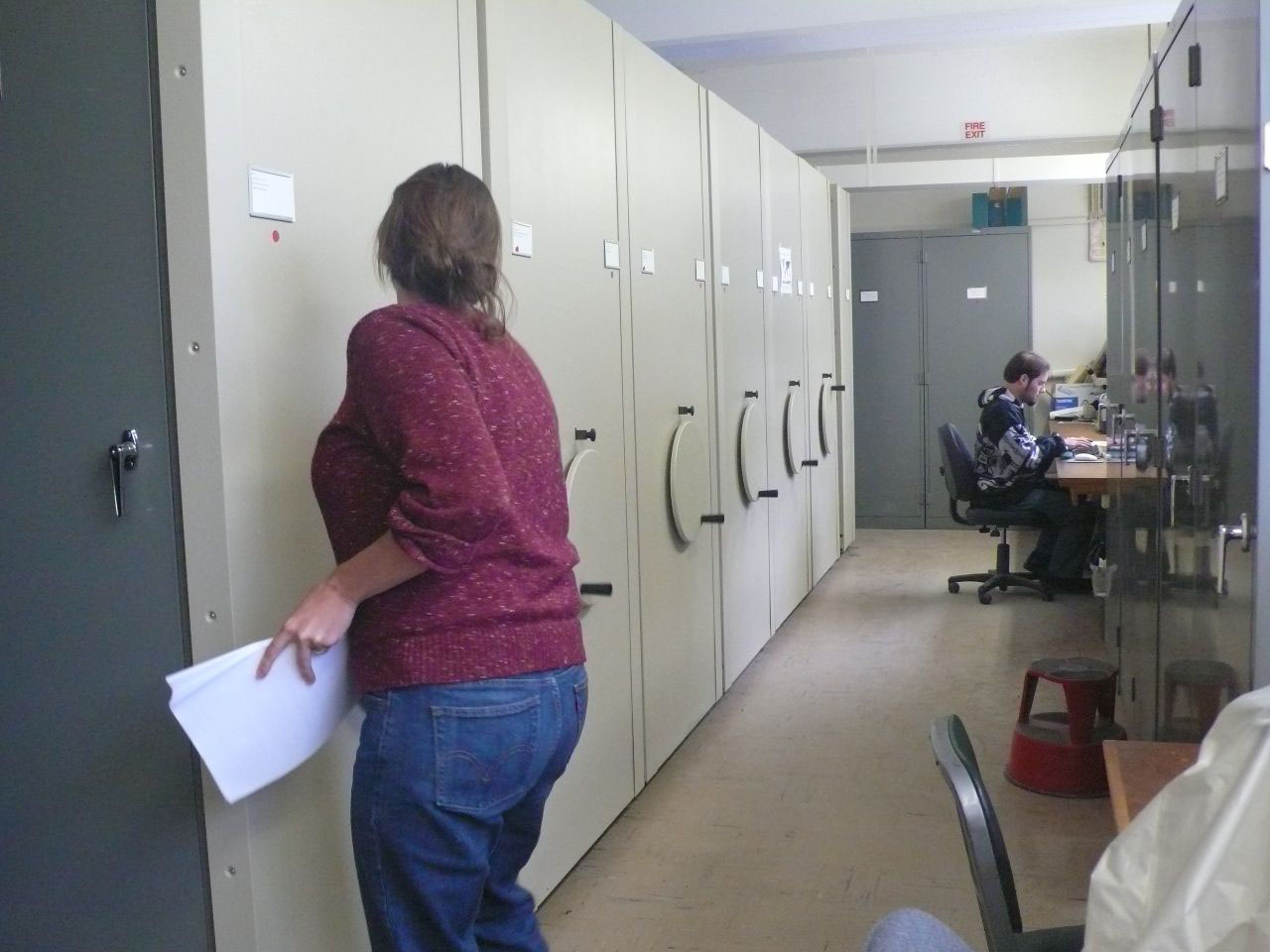
After herbarium specimens have been mounted, dried for a week, and all items securely attached, they are brought upstairs to the collection. The RSA herbarium occupies two complete floors. Here they are placed into cabinets for permanent storage. The herbarium’s more than 1 million specimens are arranged in a filing system of specially-designed cabinets. To maximize space, the cabinets line up next to each other the way the pleats of an accordion lineup next to each other. The cabinets slide and separate by turning the handles seen in this photo.

Open the door to one of the cabinets and you will find folders filled with mounted plant specimens. The large folders housing the herbarium sheets are called genus folders and they contain examples of species belonging to a given genus. For example, in the genus folder for Salvia, you might find mounted plant specimens of Salvia mellifera, Salvia nigra, etc. If you look at the genus folders located at the top of the cabinet, you’ll notice some of the folders are different colors. Genus folders are color-coded and each color represents a different region of the world.

Many of the plants in the RSA collection were collected by RSA botanists. Botanists collect three specimens of each species. They keep one and trade the other two specimens. RSA has been collecting this way since the herbarium opened in 1927. There was a collecting boom in the 1930s and 1940s. Collecting dropped off in the 1950s, however. Through continuous collecting and the acquisition of personal collections, RSA has become the 10th largest herbarium in the United States.


What happens with the specimens after they are added to the collection? Do they stay in a cabinet forever?

Not exactly. Although it may seem this way. Herbarium specimens are viewed and studied by botanists, graduate students, and other researchers. Specimens are also loaned to other herbaria. Sometimes a botanist cannot find an herbarium specimen where she/he is conducting research and they have to borrow the specimen from a distant herbarium.

Herbaria across the world have always worked cooperatively to aid researchers with their studies. The way herbaria work with each other is about to change as research facilities are using technology to their advantage. Soon researchers will no longer have to borrow specimens from distant herbaria. All they will have to do is go online to view the specimens they need. There is a huge scanning project underway and the RSA herbarium is helping to lead the way.

The scanning project is a collaborative effort of institutions worldwide. It is part of a larger movement called the Global Plants Initiative (GPI) headed by the Andrew W. Mellon Foundation. The RSA herbarium is contributing to this effort thanks to a grant from the Foundation. Rancho Santa Ana Botanic Garden has been able to obtain a digital scanner and fund the digitizing of all the type specimens at RSA. Type specimens are the original specimens used to describe a new species. In addition to the scanning of RSA’s 6,500 specimens, the type specimens at The Huntington Library, Art Collections, and Botanical Gardens, the San Diego Museum of Natural History, Santa Barbara Botanic Garden, UC Riverside, and UC Santa Barbara are also being scanned. This means that RSA alone will be responsible for digitizing 10,000 type specimens. The objective of the GPI project is to digitize representations of the world’s flora and to make these digital images available for viewing. The scanning project will not be available online to the public until 2013.

For this article, I met with Sula Vanderplank, Administrative Curator of the RSA herbarium, to learn about what goes on behind-the-scenes at the herbarium. During my visit, I had the opportunity to observe the scanning of one herbarium specimen. What a treat that was! The scanner used by the imaging team is much larger than the average office scanner, as it needs to accommodate herbarium sheets that are 12.5″ x 18″. Since dried plants are fragile and herbarium sheets cannot be placed face down on the scanner the same way a sheet of paper is normally placed onto a scanner, the scanner is the item that is inverted. The inverted scanner rests securely in place on a cart designed especially for the scanner. The scanner rests with the glass plate facing down. Herbarium sheets are placed on a platform and this platform is raised, thereby bringing the herbarium specimen to the scanner’s glass plate. The Scan button is clicked by the technician and the rest is magic. Each scan is 600 dpi and 200 MB. One scan takes 10 minutes to complete. The 10-minute scanning process includes the placement of the herbarium sheet, the actual scanning of a specimen, and the cataloging of an image. The imaging team can comfortably scan five specimens per hour.

If you have an image in your head right now about what a scanned herbarium sheet might look like, magnify the clarity of your vision by 10. The images created by the imaging team are crystal clear. The tiniest detail can be observed and when zoomed in upon, details can be viewed in an even more mind-blowing way. These herbarium images from Kew Botanic Gardens do not match what I saw in person, but they will give you an idea of what an herbarium scan looks like. Some of the images created by the RSA imaging team can be purchased in the garden’s gift shop. These images are of herbarium specimens of plants growing on the grounds at RSA. These images have been carefully mounted using archival materials and framed behind glass that protects the specimens from sunlight.

The Global Plants Initiative will not only open the world’s herbaria to researchers, but introduce the public to the diversity of plants on our planet.

Are you interested in learning more about how an herbarium works and how to create herbarium specimens? Then you might be interested in a special herbarium class taught by Sula and other key members of the herbarium staff. This class is offered only a couple times per year, so check the Rancho Santa Ana Botanic Garden Calendar regularly.


The RSA Herbarium Connects With Teachers

The Rancho Santa Ana Botanical Garden has a longstanding relationship with teachers and schools in southern California. School groups tour the garden and the herbarium during the school year. The herbarium has a special show-n-tell collection comprised of mounted plant specimens, one of the them having been collected by explorer Captain James Cook himself. To learn more about docent-led tours for K-12 students, college classes, youth groups, and adult community groups, visit the Community Education section on the RSABG website.


Question for EE Week Readers in southern California
:
Would you like to take the herbarium class at Rancho Santa Ana Botanic Garden? If so, please add your name to an Interest List for this class.


You May Also Enjoy…

Books about herbaria

Share this:

Like this:

Like
Be the first to like this post.

Posted in Education, general botany, herbarium, Special Articles & Interviews | Tagged EE Week, herbarium, National Environmental Education Week | 1 Comment

One Response

  1. on April 16, 2010 at 7:31 AM Pamela Burgess

    This is a great article – clear and informative. I’ve looked at some of the herbarium pages at RSABG and they’re quite beautiful. Also, for a special project, they sent me their scan of a type specimen which took almost a half hour to download! A huge, high resolution tiff file that does, indeed, show every spec of dust on the page. Amazing. The Global Plants Initiative (GPI) is truly an important project.


Comments are closed.

  • I’m Curious About…

  • Feature Group

    The Institute for Analytical Plant Illustration encourages botanists and illustrators to work together to enhance botanical knowledge.

    Find out how!


    Winter Aconite

    by Sue Nicholls

  • Marianne North

    Get the eBook!

  • Convenient Updates

    Subscribe to ArtPlantae Today to receive new blog posts.

  • Recent Comments

    • ArtPlantae Today on Institute Encourages Collaboration Between Botanists and Illustrators
    • Ruben Palacio on How Textbooks Contribute to Plant Blindness
    • NaiZy on Researchers Study Renaissance Herbals to Preserve the Botanical Tradition of the Ancient Mediterranean
  • What Readers Are Reading Now

    • Scientific Illustration in the Elementary School Classroom
    • Classes Near You!
    • Wendy Hollender Answers Your Questions About Botanical Drawing
    • Botany for the Artist
    • About
  • See Inside

  • Ask The Artist

    Wendy Hollender (interview)
    Wendy Hollender
    Gilly Shaeffer (interview)
    Today's Botanical Artists
    Society of Botanical Artists
    Billy Showell (interview)
    Billy Showell
    Sarah Simblet (webinar)
    Robin Brickman (interview)
    Mark Granlund (office hours)
    Wendy Hollender (webinar)
    Diane Cardaci
    Katie Lee (webinar)
    Bruce L. Cunningham (webinar)
    Jane LaFazio (interview)
    Jane LaFazio
    Mally Francis (interview)
    Kandis Elliot
    Anne-Marie Evans
    Margaret Best
    Elaine Searle
    Mindy Lighthipe
    Niki Simpson
    Anna Knights
    Helen Allen
    Birmingham Society of Botanical Artists
    Hazel West-Sherring
    John Muir Laws
    Martin J. Allen
  • Bay Area Gardens

    For San Franscisco & Coastal California

  • Teaching & Learning

    Seeing with Graphite Eyes

    Students Overcome Their Fear of Drawing in Botany Lab

    Eradicating Plant Blindness in the 21st Century

    Using Social Media to Gather Feedback About Student Interest in Natural Resource Management

    How to Draw Plants for Documentation

    Investigating the Drawing Process

    Making Students Aware of Errors During the Drawing Process

    How do you grade a sketch?

    Helping Teachers Turn Observers Into Naturalists

    Empowering Children to Know What They Know Through Art

    Lesson Plans in Botanical Art & Plant Conservation

    Anne Marie Evans Discusses Teaching, Learning & Botanical Art

    The Timeless Value of Naturalist Journals

    An Interdisciplinary Approach to Learning the Power of Plants

    Margaret Best Discusses Color in Botanical Art, Provides Tips for Informal Science Educators

    Generating Interest in Boring Subjects

    Public Perception of Botanical Gardens

    Quality Observation is the Common Denominator in Art & Science

    Botanical Wall Charts in the Classroom

    Lesson Plans in Botanical Illustration

    Practical Drawing as a Thinking Tool

    Visualizing Plants with Botanical Symbols

    Does experience in the arts lead to academic achievement?

    The Value of Words Over Botanical Illustration

    Biologist Learns to Draw Plants, Sees with New Eyes

    Visualizing Life Cycles & Ecosystems

    Niki Simpson Introduces Digital Composite Botanical Illustrations to Botanical Art

    Imagery in Scientific Communication

    The Last Botany Student in the UK

    Humans First. Then Animals. Then Plants.

    The Origin of Botanical Field Guides

    User-friendly Identification Tools for Plants & Animals

    Students Take First Step Towards Creating Unique Florilegium

    Make Students Better Observers This School Year

    The Botanical Artist as Naturalist

    Remember That Plant You Saw?

    The Arts & Everyday Learning

    Why Integrating the Arts into the Classroom May Improve Content Retention

    Watercolors of the Herbs of Britain Provide Framework for Dichotomous Key

    Learning with Journals, Notes and Scrolls

    What makes plants interesting?

    Ecoliteracy Curriculum Emphasizes Plant Restoration, Natural Dyes

    Educational Wall Charts Teach Less, Better

    Plant Identification & Environmental Literacy

    Outdoor Education & Plant Blindness

    Scholars Study Images in the Service of Science

    Botany Program for Botanical Artists Launched in UK

    Olcani: When Plants Are Medicine

    Botany Education in the 18th Century

    Thoughtful Observation

    What do textbooks teach us about plants?

    Drawing Plant Life Cycles

    Painting Hawaii's Endangered Plants

    Researchers Study Renaissance Herbals to Preserve the Botanical Tradition of the Ancient Mediterranean

  • Read Our Review

  • Nature Near You

    Botanical Gardens
    Learn about your local garden at www.publicgardens.org.

    National Park Service
    Search for national parks at the National Park Service website at www.nps.gov.

    National Environmental Education Foundation's Nature Center Guide.
    Find your local nature center.

    Rails-to-Trails
    Find a trail for hiking, walking, cycling or inline skating. The Rails-to-Trails Conservancy and its volunteers work to convert unused railroads into trails for healthful outdoor activities. Search their national TrailLink database to locate a trail near you.

    Sierra Club Trails
    Locate trails for hiking, cycling, climbing, and many other outdoor activities. Go to Sierra Club's Trails.

    Disclosure

  • Exhibits To Visit

    Plants in Peril
    Shirley Sherwood Gallery of Botanical Art
    Royal Botanic Gardens, Kew
    June 25, 2011 - Mar 11, 2012

    The Smallest Kingdom
    Shirley Sherwood Gallery of Botanical Art
    Royal Botanic Gardens, Kew
    June 25, 2011 - Mar 11, 2012

    Picturing Science: Museum Scientists and Imaging Technologies
    American Museum
    Natural History
    New York, NY
    June 25, 2011 - June 24, 2012

    A Walk in the Wild: Continuing John Muir's Journey
    Oakland Museum of California Aug. 6, 2011 - Jan. 22, 2012

    Joseph Hooker - Naturalist, Traveller and More
    Shirley Sherwood Gallery of Botanical Art
    Royal Botanic Gardens, Kew
    Nov. 12, 2011 - April 9, 2012

    Treasures of the Royal Society Library
    The Royal Society
    Dec. 5 - June 21, 2012

    Nature Morte
    The Horticultural Society
    of New York
    Dec. 7, 2011 - Feb. 10, 2012

    Portraits in Bloom
    Westport Public Library
    Westport, CT
    January 3 - March 28, 2012

    Seeing Trees: Photographs by Robert Llewellyn
    Lewis Ginter Botanical Garden
    Jan. 14 - Feb. 26, 2012

    Pepper in Image and Word
    Lloyd Library and Museum
    Cinncinati, OH
    January 14 - April 13, 2012

    Wild Green Things: The Art of Anne Ophelia Dowden
    Andersen Horticultural Library
    Minnesota Landscape Arboretum
    Chanhassen, MN
    January 18 - May 2, 2012

    Botanical Edibles:
    Wild and Cultivated

    Muroff Kotler Gallery
    Ulster County
    Community College
    Stone Ridge, NY
    January 26 - February 17, 2012

    NEW
    Common Roots
    Crossings Gallery & Gift Shop
    Zumbrota, MN
    February 1-29, 2012

    NEW
    Botanical & Natural Studies 2010-2011
    Limelight Gallery
    Lewisham Library
    Catford, London
    February 28 - April 6, 2012

    Conserving Plant Biodiversity in a
    Changing World: A View from NW North America

    UW Botancal Gardens
    Seattle, WA
    March 1-31, 2012

    Native Pennsylvania,
    A Wildflower Walk

    Hunt Institute
    Pittsburgh, PA
    March 2 - June 29, 2012

    Selections from the Reichenbachia
    Lewis Ginter Botanical Garden
    Ginter Gallery II
    March 10 - April 22, 2012

    Margaret Flockton Award Exhibition 2012
    National Herbarium of New South Wales, Australia
    March 31 - June 29, 2012

    Focus on Nature XII:
    Natural History Illustration

    New York State Museum
    April 28 - December 31, 2012

    When They Were Wild: Capturing California’s Wildflower Heritage
    The Huntington Library, Art Collections, and Botanical Gardens
    Expected 2013

    Art and Nature
    ASBA Members & Philadelphia Society of Botanical Illustrators
    Coming April 26, 2013

    Add your exhibition to this list!

  • Nature Blog Network

  • Contact Info:


    ArtPlantae LLC
    5225 Canyon Crest Drive
    Ste 71-127
    Riverside, CA 92507
    Email: info@artplantae.com Phone: 951.776.4696

    Follow ArtPlantae on Twitter http://facebooklogin.ws/2009/12/facebook-login/
  • © 2007-2012 by ArtPlantae LLC. All rights reserved. Unauthorized use and/or duplication of this material without express and written permission from this blog’s author and/or owner is strictly prohibited. Excerpts and links may be used, provided that full and clear credit is given to ArtPlantae LLC and ArtPlantae Today with appropriate and specific direction to the original content. Artists retain the copyright to their work. The ArtPlantae® logo is a registered trademark of ArtPlantae LLC.

Blog at WordPress.com.

Theme: MistyLook by Sadish.


Follow

Get every new post delivered to your Inbox.

Join 620 other followers

Powered by WordPress.com
loading Cancel
Post was not sent - check your email addresses!
Email check failed, please try again
Sorry, your blog cannot share posts by email.